
Views: 0 Author: Site Editor Publish Time: 2025-08-05 Origin: Site


Choose wood activated carbon with high purity and low ash content to ensure safety and effectiveness in medical and food applications.
Check adsorption capacity and pore size to match the specific contaminants you need to remove for optimal purification results.
Select the right particle size—fine powders for quick batch treatments and granular forms for continuous filtration and reuse.
Verify chemical compatibility to prevent unwanted reactions and maintain product integrity during sensitive processes.
Look for sustainability certifications like FSC and ISO 14001 to support eco-friendly sourcing and production.
Always confirm product certifications such as NSF, HALAL, KOSHER, and ISO to meet regulatory and quality standards.
Work with reliable suppliers who provide clear documentation, test reports, and consistent product quality.
Test sample batches before full use and follow safety guidelines to ensure safe handling and effective performance.
Wood activated carbon comes from natural wood sources. Manufacturers process the wood at high temperatures to create a material with a large surface area and many pores. This structure allows the carbon to trap and hold various substances. Activated carbon made from wood stands out for its renewable origin and eco-friendly production methods. Many industries value it for its purity and customizable properties. Activated charcoal, a form of activated carbon, often uses wood as its base material. The high porosity and surface area make wood activated carbon ideal for sensitive uses in food and medicine. Producers can adjust the pore size and surface chemistry to match specific purification needs. This flexibility supports a wide range of applications, including water and air purification.
Wood activated carbon serves many roles in both the medical and food sectors.
In the medical field, companies use it for solvent recovery, ingredient purification, and wastewater treatment. These processes help meet strict environmental and safety regulations.
In the food and beverage industry, wood activated carbon helps with decolorization, deodorization, and removal of impurities. This improves product quality and safety for consumers.
The material also supports water purification and air purification, making it valuable for clean-label trends and ultra-pure filtration.
Its natural, non-toxic, and renewable qualities align with regulatory standards and consumer demand for safe, high-purity products.
Customizable pore size and surface chemistry allow targeted filtration, which is important for both water and air treatment.
Tip: Companies often choose wood activated carbon for applications that require high purity and safety, such as pharmaceutical ingredient processing and food-grade water purification.
Wood activated carbon offers several advantages over other types of activated carbon, especially in food and medical applications.
It comes from renewable biomass, making it more sustainable and environmentally friendly than coal-based activated carbon.
The high surface area and porosity provide excellent adsorption capacity, which is critical for effective purification and treatment.
Eco-friendly activation methods reduce environmental impact during production.
In medical settings, wood activated carbon can adsorb toxins and drugs, helping with detoxification and overdose treatment.
The renewable nature and use of bio-based activation chemicals further improve its safety and sustainability profile.
Ongoing research continues to improve the consistency and efficiency of wood activated carbon, addressing challenges related to biomass variability.
Activated carbon’s ability to bind a wide range of toxins makes it a trusted choice for medical emergencies. Its effectiveness in water purification and air treatment also supports public health and product safety.
Purity stands as the most important factor when selecting wood activated carbon for medical or food use. High purity ensures that the activated carbon does not introduce unwanted substances into sensitive products. Manufacturers must pay close attention to the source and processing methods to achieve the required purity levels.
Low ash content is essential for activated carbon used in medical and food areas. Ash consists of inorganic minerals that remain after burning the carbon source. High ash levels can reduce adsorption efficiency and introduce unwanted minerals into the final product. Regulatory standards require activated carbon for pharmaceutical and food applications to have minimal ash content. This ensures consistent performance and safety for each application purpose.
The following table summarizes international purity requirements for activated carbon in different application areas:
Application Area | Purity/Quality Requirements | Certifications/Standards | Key Features/Notes |
|---|---|---|---|
Medical (Pharmaceutical Grade) | High purity level, low ash content, controlled particle size, batch-to-batch consistency | USP/EP/JP compliant | Engineered for API purification and pharmaceutical processing; ultra-fine powder (325 mesh) |
Food Grade | High purity suitable for food and beverage industry | NSF, HALAL, KOSHER, food safety regulations | Optimized pore structure for impurity removal without affecting product quality; fine powder (200-325 mesh) |
General Quality | Consistent product quality, third-party inspection | ISO 9001, SGS | Multiple international certifications ensuring quality and safety |
Activated carbon must be free from impurities such as heavy metals, residual chemicals, and organic pollutants. These impurities can compromise the safety and effectiveness of the product. Manufacturers use advanced washing and activation processes to remove impurities from the carbon source. Consistent quality checks help ensure that activated carbon meets strict standards for medical and food areas. Purity not only protects consumers but also supports the application purpose by maintaining the integrity of water, air, and pharmaceutical products.
Adsorption capacity measures how much activated carbon can trap and hold contaminants. This property depends on the surface area and pore structure of the carbon. Activated carbon used in pharmaceutical and food industries often has a surface area exceeding 3400 m²/g and can adsorb up to 2000 mg/g of contaminants. High adsorption capacity allows the carbon to remove a wide range of impurities, including toxins, colorants, and unwanted flavors. The application purpose determines the required adsorption capacity, with medical areas needing ultra-high performance for pollutant adsorption and purification.
Tip: Always check the adsorption capacity listed in product specifications. Higher values mean better performance in removing contaminants from water, air, and food products.
Pore size distribution plays a key role in the effectiveness of activated carbon. The pores must match the size of the contaminants targeted for removal. Micropores work best for small molecules, while mesopores and macropores help adsorb larger contaminants. Over time, larger molecules can block mesopores, reducing access to micropores and lowering overall adsorption efficiency. Activated carbon with a balanced pore structure, especially higher mesopore volume, maintains strong adsorption capacity and long-term performance.
Activated carbon derived from different sources, such as walnut shells or jujube seeds, shows varied pore size distributions. Mesopore-rich activated carbon demonstrates higher adsorption capacity for large contaminants, which is crucial for food and medical areas. Optimizing pore structure improves the removal of diverse impurities and supports the application purpose in purification processes.
Particle size plays a critical role in the performance of activated carbon for medical and food applications. Smaller particles offer a larger surface area, which increases the rate of adsorption. This means that contaminants can be removed more quickly and efficiently. Fine powdered activated carbon is often used in batch processes, such as decolorization and impurity removal in food and pharmaceuticals. These fine powders disperse easily in liquids, allowing for rapid contact with impurities.
Granular activated carbon, with larger particle sizes, works well in continuous filtration systems. It provides lower pressure drop and can be easily separated from liquids after treatment. The choice between powdered and granular forms depends on the specific process requirements. For example, powdered activated carbon is ideal for quick, one-time treatments, while granular forms are better for ongoing filtration.
Manufacturers must select the appropriate particle size to match the application. Consistent particle size ensures predictable performance and helps maintain product quality. In medical and food industries, strict controls on particle size prevent contamination and ensure the activated carbon meets regulatory standards.
Tip: Always review the product specifications for particle size distribution. This helps ensure the activated carbon will perform as expected in your process.
Chemical compatibility determines how well activated carbon performs in different environments. Not all activated carbon grades work with every chemical or contaminant. Some grades are acid washed to remove acid-soluble ash, making them suitable for use in acidic environments. These carbons can handle acids such as hydrochloric, phosphoric, and sulfuric acids. They also treat organic acids like formic, acetic, propionic, succinic, oxalic, lactic, malic, and benzoic acids.
Activated carbon products designed for food and pharmaceutical use, such as Acticarbone, CPG, CENTAUR, and FILTRASORB, meet strict chemical compatibility and purity standards. This prevents contamination or degradation during sensitive processes. Different activated carbons have unique chemical affinities. It is important to research the specific contaminants targeted for removal. Selecting activated carbon that matches the chemical properties of the contaminants, such as chlorinated compounds, improves effectiveness.
Acid-washed activated carbon is suitable for acidic environments.
Some products are formulated for specific food and pharmaceutical applications.
Compatibility with targeted contaminants ensures optimal adsorption and safety.
Choosing the right chemical compatibility protects both the process and the final product. It also supports regulatory compliance in medical and food industries.
Sustainability has become a key factor when selecting activated carbon for medical and food use. Responsible sourcing and production help protect the environment and support long-term supply. Several certifications and standards guide sustainable practices in the industry.
FSC (Forest Stewardship Council) certification ensures wood comes from responsibly managed forests.
PEFC (Programme for the Endorsement of Forest Certification) verifies sustainable forest management.
Rainforest Alliance certification promotes biodiversity and sustainability in forestry products.
Fairtrade certification supports ethical production and environmental protection.
ISO 14001 certification demonstrates a manufacturer’s commitment to minimizing environmental impact. This standard covers environmental management systems and helps companies improve resource efficiency, reduce waste, and comply with environmental laws. The WQA Sustainability Certification program uses life-cycle analysis to address environmental, social, and economic impacts. NSF/ANSI Standards 42 and 61 focus on the safety and quality of activated carbon, with special requirements for regenerated carbon to encourage reuse.
Companies that choose activated carbon with recognized sustainability certifications show their commitment to environmental responsibility and product safety.
Sustainable activated carbon production not only protects natural resources but also meets consumer demand for eco-friendly products. This approach supports both business goals and global environmental efforts.

Ensuring the right wood activated carbon for medical or food use requires strict attention to quality standards. Companies must select products that meet recognized certifications and comply with international regulations. These steps protect consumers and guarantee reliable performance in sensitive applications.
Certifications confirm that wood activated carbon meets industry requirements for purity, safety, and environmental responsibility. Manufacturers often seek multiple certifications to show their commitment to high quality.
Food-grade activated carbon must pass several tests before use in food processing. Products with NSF, HALAL, and KOSHER certifications meet important dietary and safety requirements. NSF certification shows that the activated carbon complies with international safety and quality standards. HALAL and KOSHER certifications ensure the product fits religious dietary laws, which is important for many food markets.
Certification | Industry Application | Description |
|---|---|---|
NSF | Food & Pharmaceutical | Internationally recognized certification ensuring compliance with safety and quality standards. |
HALAL | Food & Pharmaceutical | Certification ensuring products meet Islamic dietary laws, important for food and pharma markets. |
KOSHER | Food & Pharmaceutical | Certification ensuring compliance with Jewish dietary laws, relevant for food and pharma. |
Tip: Always check for food-grade certifications when selecting activated carbon for food processing. These certifications help ensure product safety and consumer trust.
Pharmaceutical-grade activated carbon must meet even stricter standards. ISO9001 certification confirms that the manufacturer uses a quality management system to produce consistent products. ISO14001 certification shows that the company follows environmental management practices. These certifications are highly recognized in the pharmaceutical sector and support safe, sustainable production.
Certification | Industry Application | Description |
|---|---|---|
ISO9001 | Food & Pharmaceutical | Quality management system certification ensuring consistent product quality. |
ISO14001 | Food & Pharmaceutical | Environmental management system certification, indicating sustainable production. |
Pharmaceutical-grade activated carbon must also meet performance and safety standards set by regulatory agencies. These standards help protect patient health and ensure the activated carbon works as intended.
Regulatory compliance varies by region but always focuses on protecting public health and the environment. In Europe, companies must follow strict environmental regulations and comply with ISO and EPA standards. The European market values eco-friendly filtration and advanced technologies. In North America, regulations target emission reduction and pollutant control. The market encourages sustainable practices and innovation. Asia Pacific countries increase environmental regulations and focus on local production and cost-effective solutions.
Region | Regulatory Compliance Focus | Market Characteristics and Drivers |
|---|---|---|
Europe (EU) | Stringent environmental regulations; compliance with ISO and EPA standards; strong health and safety regulations; government incentives for sustainability | Emphasis on eco-friendly filtration, advanced activated carbon technologies, especially in water treatment and air purification; innovation driven by carbon footprint reduction and renewable energy promotion |
North America (US, Canada) | Strict regulatory frameworks targeting emission reduction and pollutant control; evolving industry standards | Focus on sustainable industrial practices and technological innovation; integration of smart and bio-based manufacturing processes; regulatory shifts accelerating market expansion |
Asia Pacific (China, India, Japan) | Increasing environmental regulations; compliance with regional standards; emphasis on local production and cost-effective solutions | Rapid industrialization and urbanization driving demand; government initiatives promoting sustainable practices and waste management; product customization for diverse industries |
Manufacturers must provide clear documentation to prove compliance with these standards. Supplier transparency helps buyers verify product quality and regulatory status. Companies should request certificates and test reports before purchasing activated carbon for medical or food use.
Note: Verifying documentation and supplier transparency ensures that activated carbon meets all required standards and protects end users.

Activated carbon comes in several forms, but powdered and granular types are the most common for medical and food applications. Each form offers unique benefits and fits specific processing needs. Understanding the differences helps companies choose the best option for their purification goals.
Powdered activated carbon, often called PAC, features very fine particles, usually less than 100 micrometers. This small size gives it a large surface area, which leads to rapid adsorption of contaminants. In food processing, powdered activated carbon removes color, odor, and unwanted by-products. It improves the taste and purity of sweeteners and other ingredients. Medical industries use it to purify liquids and control taste and odor in sensitive products.
The fine particles allow for quick mixing and fast treatment cycles. Companies often add powdered activated carbon directly to liquids, then filter it out after it absorbs impurities. This method works well for sudden pollution events or short-term treatments. However, handling powdered activated carbon can create dust and increase sludge, which may complicate disposal. Some equipment may also experience head loss when using this form.
Tip: Powdered activated carbon works best for batch processes or when a fast response to contamination is needed.
The following table highlights the main differences between powdered and granular activated carbon:
Aspect | Powdered Activated Carbon (PAC) | Granular Activated Carbon (GAC) |
|---|---|---|
Particle Size | Mostly passes fine sieves (e.g., 325 mesh) | Larger, formed particles |
Adsorption Capacity | Larger total surface area, faster adsorption | Strong adsorption but slower kinetics |
Application in Water Treatment | Used for removing color, odor, taste, trace organics; dosed in mg/L | Used for advanced treatment, often combined with sand filters |
Operational Advantages | Simple method, fast adsorption cycle, lower cost | Stable bed, easy replacement, less movement and clogging |
Limitations | Difficult to control, increases sludge, dust formation | Higher cost, but reusable and durable |
Typical Usage Scenarios | Sudden pollution events, short-term treatment | Continuous treatment, solvent recovery, air purification |
Granular activated carbon, or GAC, consists of larger particles formed into stable shapes. This form is popular for continuous filtration systems in both food and pharmaceutical industries. Granular activated carbon creates a stable filter bed that resists movement and clogging. Companies use it for advanced water treatment, solvent recovery, and air purification.
In the food industry, granular activated carbon purifies large streams of colored liquids, such as those found in beverage production. It works well in continuous processes, where it can be regenerated and reused. Pharmaceutical companies rely on granular activated carbon for decolorization and purification of sensitive solutions, including injectable drugs and antibiotics. Its durability and reusability make it cost-effective for high-volume operations.
Industry | Use Case Description | Product Form / Characteristics |
|---|---|---|
Food Industry | Purification of large streams of colored liquids in continuous processes; used in agro-food and beverage markets | Granular Acticarbone® BG designed for large stream purification |
Pharmaceutical Industry | Decolorization and purification of sensitive liquids such as injectable pharmaceutical solutions (e.g., contrast media, antibiotics) | Powdered and washed powdered Acticarbone® with high purity and adsorption capacity |
General Features | High purity, large adsorption capacity, suitable for specialty applications like decolorization, purification, and decontamination | Wood-based activated carbon with certifications (ISO 9001, oenological codex, kosher, halal) |
Granular activated carbon offers slower adsorption rates compared to powdered forms, but it provides operational stability and easier handling. It produces less sludge and can be regenerated, reducing waste and long-term costs.
Note: Granular activated carbon is ideal for continuous, large-scale purification where durability and reusability matter most.
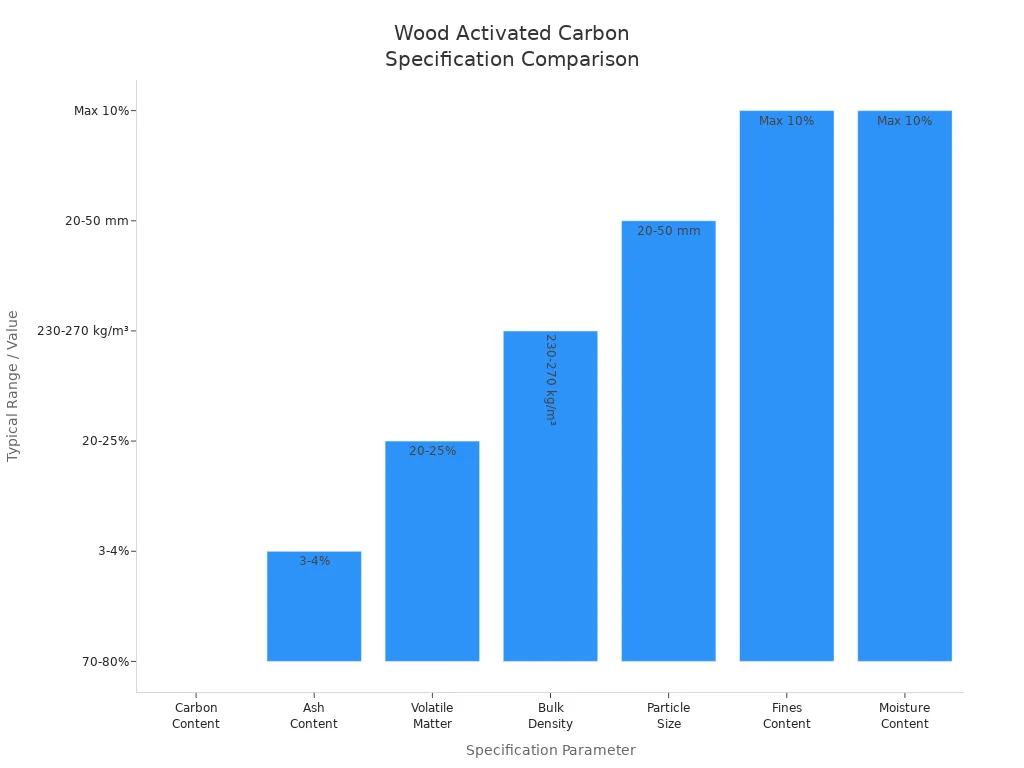
When comparing wood activated carbon products for medical or food use, buyers should focus on key specification parameters. These parameters help determine if the product will meet safety and purification needs. The following table summarizes important values to review:
Parameter | Typical Range / Value | Importance for Medical/Food Use |
|---|---|---|
Carbon Content | 70-80% | High carbon content indicates purity and adsorption efficiency |
Ash Content | 3-4% | Low ash content preferred to avoid impurities |
Volatile Matter | 20-25% | Affects adsorption and product stability |
Bulk Density (dry) | 230-270 kg/m³ | Influences packing and filtration characteristics |
Particle Size | 20-50 mm (average) | Affects flow and filtration speed |
Fines Content (<6.35mm) | Max 10% | Low fines content reduces clogging and dust |
Moisture Content | Max 10% | Low moisture ensures product stability and performance |
Physical strength and fracture resistance also matter. These features help maintain product integrity during handling and use. Buyers should also check adsorption capacity, pore size distribution, and activation method. These factors influence how well activated carbon removes contaminants from liquids or gases.
Tip: Always compare product datasheets side by side. This makes it easier to spot differences in purity, particle size, and other critical features.
Choosing the right supplier is just as important as selecting the right product. Reliable suppliers provide clear documentation and consistent quality. Buyers should look for suppliers with recognized certifications, such as ISO9001 for quality management and NSF for food safety. Transparent suppliers share test reports and answer questions about sourcing and processing.
A good supplier will:
Offer detailed product specifications and test results.
Provide certificates for food-grade or pharmaceutical-grade activated carbon.
Maintain strong quality control during production.
Respond quickly to customer questions and requests.
Note: Building a relationship with a trusted supplier helps ensure a steady supply of high-quality activated carbon for sensitive applications.
Sample testing verifies that activated carbon meets strict standards for medical and food use. Laboratories test for adsorption capacity, purity, and safety. The table below lists common test parameters and their limits:
Test Parameter | Requirement / Limit |
|---|---|
Methylene Blue Adsorption | Minimum 120 ml/g |
Moisture Content | ≤ 10% |
Ash Content | ≤ 7% |
Iodine Value | 900-1200 mg/g |
Density | 450-550 g/l |
pH | 5-7 |
Granularity | Powder |
Chloride | Maximum 0.05% |
Acid Soluble Iron | Maximum 0.05% |
Heavy Metals | Maximum 30 ppm |
Ferric Salt | Maximum 0.02% |
Zinc Salt | Maximum 0.005% |
Microbial Limits | Mold and Yeast ≤ 100 |
Aerobic Bacteria Count | ≤ 1000 CFU |
Absence of Escherichia coli and Salmonella | Must be absent |
Bacterial Endotoxin | ≤ 2 Eu/g |
Suction Volume | Not less than 1.2 - 1.4 ml |
Sulfide and Cyanide Reaction | No reaction |
Dissolved Substances in Ethanol | ≤ 8 mg |
Fluorescent Absorbance | Less than control solution |
Adsorption Capacity for Bacterial Endotoxin | Reduction by two orders of magnitude |

Testing ensures the activated carbon will remove contaminants effectively and remain safe for use in food or medicine. Regular sample testing helps maintain high standards and supports reliable performance in every batch.
A clear checklist helps buyers select the right wood activated carbon for medical or food use. This list covers the most important steps:
Review product certifications for food-grade or pharmaceutical-grade use.
Check purity levels, including low ash content and absence of heavy metals.
Confirm the adsorption capacity matches the intended application.
Examine particle size and pore size distribution.
Request documentation on chemical compatibility.
Ask for sustainability certifications, such as FSC or ISO 14001.
Test a sample batch before full-scale use.
Follow safety precautions during handling and storage.
Tip: Use this checklist as a quick reference when evaluating new suppliers or products.
Many companies make common mistakes when choosing activated carbon. Avoiding these errors can save time and protect product quality.
Ignoring the specific requirements of the application may lead to poor performance.
Overlooking safety precautions can result in contamination or health risks.
Failing to verify certifications and documentation may cause regulatory issues.
Selecting the wrong particle size can reduce filtration efficiency.
Not testing a sample before purchase increases the risk of unexpected results.
Disregarding guidelines for incorporating activated carbon into processes may affect product safety.
Note: Always follow established precautions and guidelines to ensure safe and effective use.
Asking the right questions helps buyers find reliable suppliers and high-quality products. Consider these questions during the selection process:
Question | Why It Matters |
|---|---|
What certifications does your activated carbon hold? | Confirms suitability for food or medical use |
Can you provide recent test reports? | Verifies purity and adsorption capacity |
How do you ensure batch-to-batch consistency? | Ensures reliable performance |
What are your safety precautions for handling? | Protects workers and end users |
Do you offer guidance on application and use? | Supports proper integration into processes |
What sustainability certifications do you have? | Shows commitment to responsible sourcing |
Can you supply documentation on chemical compatibility? | Prevents unwanted reactions in sensitive uses |
Tip: Keep these questions handy when contacting new suppliers. Clear answers help ensure the activated carbon meets all requirements.
Selecting wood activated carbon for medical or food use involves several key steps:
Choose clean, high-quality wood with low ash content.
Ensure thorough drying and proper activation for optimal pore structure.
Test for purity, adsorption capacity, and compliance with industry standards.
Verify certifications such as NSF, KOSHER, HALAL, and ISO 9001.
Expert advice: Always request documentation, sample test results, and Certificates of Analysis from suppliers.
Consider application needs, chemical compatibility, and sustainability.
Consult industry resources or specialists for guidance before purchasing.
Making informed choices protects product safety and supports regulatory compliance.
Wood activated carbon removes impurities, colors, and odors from liquids and gases. Food companies use it for sugar refining and beverage purification. Medical industries rely on it for ingredient purification and detoxification processes.
Buyers should request Certificates of Analysis and recent laboratory test reports. These documents confirm low ash content, absence of heavy metals, and compliance with food or pharmaceutical standards.
Particle size affects adsorption speed and filtration efficiency. Fine powders work best for rapid treatment in batch processes. Granular forms suit continuous filtration systems and allow for easier handling and regeneration.
Food-grade activated carbon should carry NSF, HALAL, and KOSHER certifications. These ensure the product meets international safety and dietary requirements for food processing.
Granular activated carbon can often be regenerated and reused, especially in large-scale filtration systems. Powdered forms are usually single-use due to their fine structure and handling requirements.
Wood activated carbon comes from renewable wood sources and offers high porosity. Coal activated carbon, like PURESTAR’s Coal Activated Carbon, provides strong mechanical strength and cost-effectiveness for industrial applications.
Users should wear gloves, masks, and protective clothing to avoid inhaling dust or skin contact. Proper ventilation and safe storage help prevent accidents and maintain product quality.
Buyers should check for certifications, request regulatory documentation, and confirm supplier transparency. Reliable suppliers provide clear evidence of compliance with food and pharmaceutical regulations.


