
Views: 0 Author: Site Editor Publish Time: 2025-12-05 Origin: Site


Have you ever wondered if bamboo charcoal and activated carbon are the same? Both are commonly used for purification, but they are not identical. While they share some similarities, their differences make them suitable for different applications.
In this article, we will discuss the key differences between bamboo charcoal and activated carbon. You'll learn how to choose the right one for your needs, whether for home, industrial, or medical use.
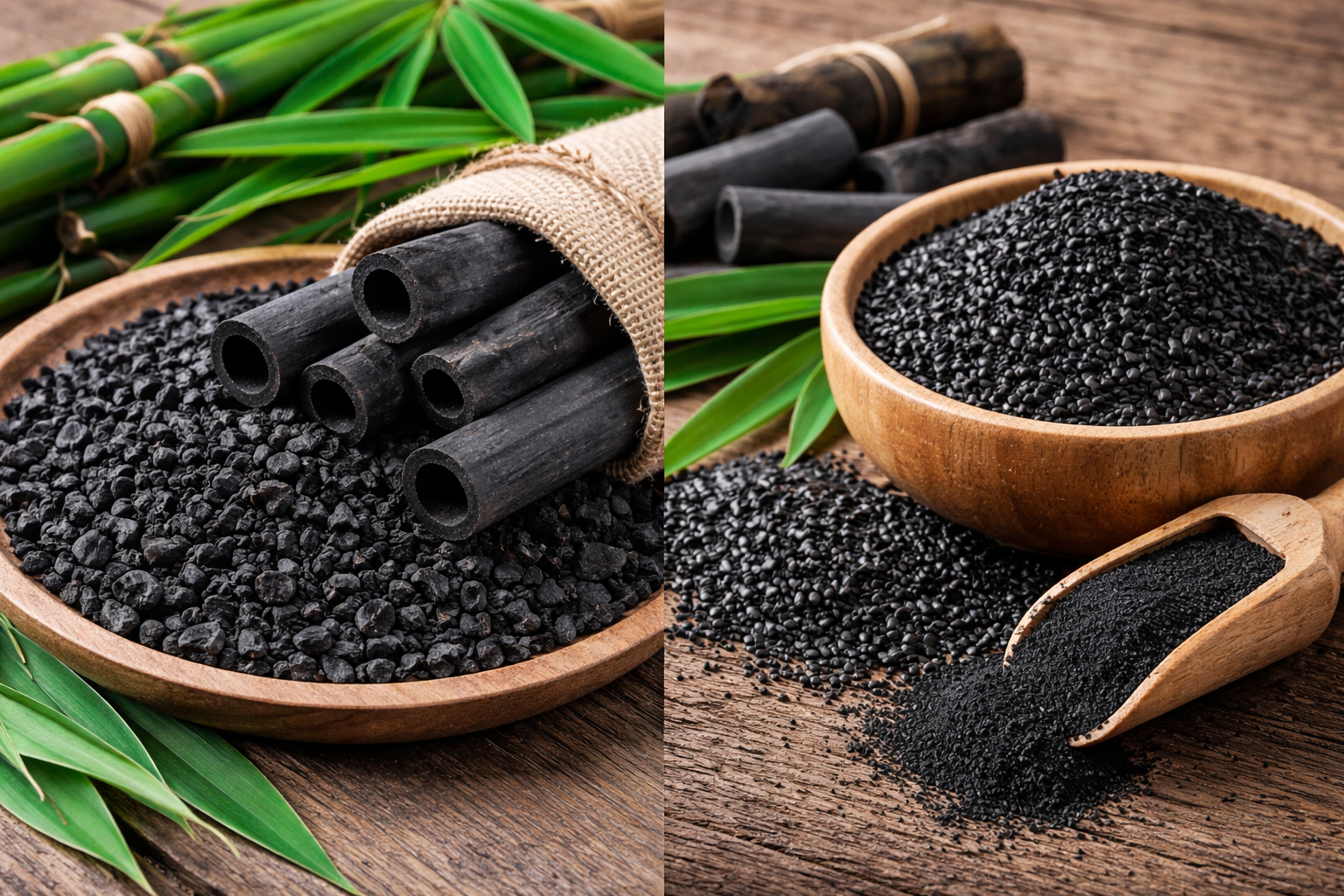
Bamboo charcoal is produced through a process called carbonization, where bamboo stalks are heated to high temperatures (usually between 800°C to 1200°C) in an environment with limited oxygen. This high-temperature treatment removes volatile substances from the bamboo, leaving behind a dense, porous structure that can absorb moisture and some odors. Unlike activated carbon, bamboo charcoal does not undergo an additional "activation" process to enhance its absorption properties, which limits its effectiveness for certain applications.
The process of carbonization involves a delicate balance of heat and oxygen deprivation, which transforms the bamboo into a solid, carbon-rich material. While this method produces an eco-friendly and natural material, it also means bamboo charcoal’s absorptive qualities are not as enhanced as those of activated carbon.
Bamboo charcoal has a wide range of household applications. It is commonly found in air purifiers, where it helps absorb moisture and mild odors, improving the air quality in homes and offices. It is particularly useful in spaces with high humidity, such as bathrooms and kitchens. Additionally, bamboo charcoal is often used as a natural fertilizer in gardening due to its ability to enhance soil health by maintaining soil moisture and regulating pH levels, making it an excellent choice for sustainable agriculture.
Bamboo charcoal is also popular in personal care products like facial masks, where it helps absorb excess oils and impurities from the skin, providing a natural, non-chemical alternative to conventional skincare treatments. The material’s versatility extends to use in shoe deodorizers, pet care, and even in some forms of alternative medicine.
Activated carbon undergoes a more complex and intensive process than bamboo charcoal. The raw material, such as coal, coconut shells, or wood, is first carbonized at high temperatures to remove volatile gases. It’s then subjected to an additional treatment with steam or chemicals (like phosphoric acid or zinc chloride), which "activates" the carbon, increasing the material's surface area and pore volume. This activation process significantly enhances its ability to adsorb a wide range of pollutants.
The process not only increases the internal surface area of the carbon but also creates millions of tiny pores, making activated carbon far more efficient at trapping impurities than non-activated forms like bamboo charcoal. This added complexity makes activated carbon more versatile for industrial applications but also more costly to produce.
Activated carbon is renowned for its powerful ability to absorb a wide range of toxins, chemicals, and pollutants, making it essential in many industries. It is primarily used in water filtration systems, where it removes contaminants like chlorine, volatile organic compounds (VOCs), pesticides, and heavy metals from drinking water. This ability to purify water has made it a standard in both household filters and large-scale municipal water treatment.
Activated carbon is also widely used in air purification systems. Its superior adsorption properties make it highly effective at trapping airborne pollutants, including gases, odors, and particulate matter. In the medical field, activated carbon is a critical tool for treating poisoning or overdose, as it can adsorb toxins in the stomach and prevent their absorption into the bloodstream, providing an emergency intervention in critical situations.
One of the key differences between bamboo charcoal and activated carbon lies in their pore structure. Bamboo charcoal, while porous, has a much lower surface area compared to activated carbon. Activated carbon’s pore structure is far more intricate, as the activation process creates millions of tiny pores that drastically increase its surface area. This is what makes activated carbon such an effective material for absorbing a wide range of substances, from gases to liquids.
The larger pores in bamboo charcoal, while still useful for absorbing moisture and mild odors, are not as effective for capturing harmful chemicals and pollutants. Bamboo charcoal’s lower surface area means it can only absorb a limited amount of substances, making it more suitable for everyday, low-efficiency uses rather than more demanding applications that require high-efficiency purification.
Activated carbon outperforms bamboo charcoal in adsorption strength due to its high surface area and the fine structure of its pores. Activated carbon is able to trap harmful substances such as bacteria, viruses, and toxic chemicals in its pores, which makes it the preferred material for tasks like water and air purification. Bamboo charcoal, on the other hand, has a less refined pore structure, which limits its ability to adsorb substances like pollutants or fine particles.
In fact, the adsorption efficiency of activated carbon can be so high that a single gram of activated carbon has a surface area comparable to several football fields. This extreme porosity allows activated carbon to be highly effective in scenarios requiring rapid and thorough absorption of harmful substances.
| Feature | Bamboo Charcoal | Activated Carbon |
|---|---|---|
| Production Process | High-temperature carbonization | Carbonization followed by "activation" process |
| Pore Structure | Larger pores, lower surface area | Millions of tiny pores, high surface area |
| Adsorption Efficiency | Moderate, mainly for moisture and odors | High, effective at adsorbing toxins and pollutants |
| Common Applications | Air purifiers, soil amendments, personal care | Water filtration, air purification, medical use |
| Cost | Lower cost | Higher cost due to complex production process |
| Sustainability | Eco-friendly, biodegradable | Not biodegradable, requires proper disposal |
Bamboo charcoal is a versatile material often used in everyday products. It is commonly found in air purifiers and humidity regulators, where it helps maintain a comfortable environment by absorbing excess moisture and neutralizing odors. Bamboo charcoal can also be used to prevent mold growth and remove stale smells from closets, shoes, and other enclosed spaces.
In addition to its air-purifying properties, bamboo charcoal is frequently used in the garden as a soil amendment. It helps retain moisture, improves drainage, and balances the soil’s pH, which can lead to healthier plants. It’s also commonly included in personal care products, such as facial masks, where it helps to absorb oils and cleanse the skin naturally.
For more insights on improving indoor air quality using bamboo activated carbon, check out this guide.
Activated carbon plays a crucial role in many industrial applications. It is widely used in water treatment plants to remove contaminants, including chlorine, fluoride, and heavy metals. Activated carbon is also used in gas masks and air purifiers to filter out harmful gases and particles. In the medical field, it is used to treat poisoning or overdose, as it can adsorb toxins in the stomach and prevent them from entering the bloodstream.
In addition to its medical uses, activated carbon is essential in other industries, such as mining, where it helps extract gold and other valuable metals from liquids, and in the food industry, where it’s used to remove color and keep food fresh.
Bamboo charcoal is praised for its natural, eco-friendly properties. It is made from a renewable resource and is biodegradable, making it a sustainable choice for those looking to reduce their environmental footprint. Bamboo charcoal is also more affordable and requires less complex production methods compared to activated carbon.
However, its absorption capacity is limited compared to activated carbon. Bamboo charcoal is best suited for tasks like moisture control and mild odor removal in small spaces. For more demanding purification needs, such as air and water filtration, bamboo charcoal is less effective.
Activated carbon is highly effective at trapping a wide range of substances due to its extensive surface area and fine pore structure. It excels in water and air purification and is a vital component in medical treatments for poisoning. However, it tends to be more expensive and requires a more complex production process compared to bamboo charcoal. Additionally, activated carbon is not biodegradable and must be disposed of properly after use.
Despite its higher cost, activated carbon is indispensable in industrial, medical, and high-performance consumer applications. Its powerful absorption capabilities make it a go-to material for cleaning and purification.
| Feature | Bamboo Charcoal | Activated Carbon |
|---|---|---|
| Advantages | - Eco-friendly, renewable material | - Powerful adsorption capacity |
| - Affordable | - Highly effective in removing pollutants | |
| - Biodegradable | - Used in industrial, medical, and consumer products | |
| - Versatile in household and personal care | - Excellent for high-efficiency purification | |
| Disadvantages | - Limited absorption capacity | - Higher cost due to production complexity |
| - Less effective in purifying air or water | - Not biodegradable | |
| - Not ideal for industrial use | - Requires proper disposal |
Bamboo charcoal is a great choice for those looking for an eco-friendly option for everyday needs. It is ideal for use in areas where moisture and mild odors need to be absorbed, such as in closets, bathrooms, and refrigerators. It’s also a perfect addition to garden soil, enhancing plant growth and improving soil conditions. Bamboo charcoal’s natural properties make it suitable for sustainable, low-efficiency tasks, but it’s not as effective for large-scale purification needs.
For tasks requiring high-efficiency purification, such as water filtration, air purification, or toxin removal, activated carbon is the preferred choice. Its ability to trap a wide variety of harmful substances makes it the best material for industrial and medical applications. If you need to remove strong odors, chemicals, or contaminants, activated carbon is the best option, offering superior performance in these areas.
In summary, bamboo charcoal and activated carbon, though both carbonized, serve different purposes. Bamboo charcoal excels in moisture and odor control for household use, while activated carbon is more effective for high-efficiency purification, especially in air and water. When choosing between them, consider your specific needs. For those looking for advanced environmental solutions, Jiangsu PURESTAR Environmental Protection Technology Co., Ltd. offers high-quality activated carbon products, providing excellent performance in purification processes.
A: Bamboo charcoal is made through carbonization, primarily for moisture and odor control in household uses. Activated carbon undergoes an activation process that increases its surface area, making it more effective for purifying air and water due to its stronger absorption properties.
A: Activated carbon is widely used in water filtration systems due to its high surface area, which allows it to adsorb impurities like chlorine, heavy metals, and organic compounds, providing clean, purified water.
A: Yes, bamboo charcoal is effective for absorbing moisture and mild odors in household environments. However, it is less efficient than activated carbon in purifying air from harmful gases and toxins.
A: Activated carbon has a higher surface area due to its activation process, which allows it to adsorb a wider range of contaminants in water, making it far more effective than bamboo charcoal for purification.
A: Activated carbon typically costs more than bamboo charcoal because of its complex production process, which includes the activation phase that significantly enhances its adsorption capacity.


